Pages

Sunday, January 21, 2018

Mapping a Better Tommorow

This unit in Thin Red Lines, my class learned about the importance of maps. Before this class, I had always thought of maps as just being a tool to get around the city. But after taking this class, my idea about maps have broadened. Maps can be used as a tool to get around, more importantly, they tell a story.  Maps can tell an interesting story, meaning having one perspective; it's important how you map an area because it can skew your idea about a place. Thin Red Lines has been an exciting class, one FE I really enjoyed was going to Google. We went to Google to talk and ask questions to people who worked with Waze and partnered with Google. I learned that although they'd like to map history and important information regarding each community, it is hard to make a functioning map that helps people get around as well as tell information. For this AP,  I had to create 3 separate maps about a specific community by representing and revolving conflicts amongst the people who live there. This AP took lots of researching for data and choosing which data best improved my argument. In the end, I think my final AP came out decent. Below are my maps, enjoy!


Map 1:


The first map of Bronzeville displays what type of assets are in the neighborhood. As a cartographer. I wanted to accurately portray Bronzeville as what it is; to get exact locations I explored Google Maps and searched for locations where there are vacant lots, stores, high schools, etc. Vacant lands are black on the map, hospitals are in navy, TIF in brown,  Liquor stores in red, fast food restaurants in yellow, and high schools in white. In Bronzeville, there a lot of vacant spaces, this shows that developers aren’t investing in the area. These mass amounts of vacant lots also make the area look blighted; it makes others and the people who live in that area think negatively about Bronzeville. The Bronzeville TIF only covers a small part of the neighborhood, where the entire area is in desperate need of help. I decided to map the green and red line to show that there are train stations near. Transportation is important for every neighborhood, it allows people to travel around the city for opportunities. I mapped high schools in the area to show there are a few high schools in the area. After looking at each schools’ stats on Niche, I found but they aren’t performing as well as schools in the city. I asked my family members if they could fix something about Bronzeville what it would be, my mom said that she wished there were more grocery stores with better food options like Trader Joes or Whole Foods. She said that she ends up buying a lot of snacks instead of food when she shops at Walgreens or Marianos. I decided to include grocery stores on my map to show that there aren’t enough grocery stores to supply food for the number of people or families living in Bronzeville. As you can see, there is more fast food restaurant than there are grocery stores, where people can buy real and healthy food. To continue to map this idea of food, I mapped fast food restaurants. If there are more fast food restaurants than grocery stores, it is more likely that someone will spend less money for more amounts of food at Mcdonalds. This affects the people living in the neighborhood mentally and physically. In order to keep the body and mind functioning properly, you must eat food that nourishes the body instead of destroying it. To juxtapose that idea of having more fast food restaurants than grocery stores, I mapped hospitals in the area. As shown on the map, there are 4 hospitals in Bronzeville. I don’t think a community would need that many if the people were eating well and taking care of their bodies. If there are more fast food restaurants that led to illnesses, there is going to be a higher demand for hospitals in the area. In addition, I mapped liquor stores to again highlight the proportion of things that can negatively affect the community than there are places that could benefit the people. Based on data from CMAP, people living in the Bronzeville have the highest rate of deadly diseases. This could be from the mass amounts of liquor stores and fast food restaurants or lack of grocery stores. This map notes that across from a high school you can find a fast food restaurant, a liquor store and a hospital: a recipe for disaster.


Map 2:


The second map of Bronzeville displays changes in the area based on community demands. I took the assets that were on the first map and changed the property and added something beneficial to the community. To help the entire community, I expanded the TIF through the whole Bronzeville area. This would help redevelopment of the community by getting rid of those vacant spaces and instead of adding residency or businesses that would improve the area. I brought in more residencies(displayed in maroon) to make the neighborhood have a better sense of community, as well as bring in more families into Bronzeville. According to CMAP, Bronzeville has a plan to develop the area into a mixed-use area that provides commercial and residential spaces. 53% of the current land is residency, while the next highest percentage is 14% being vacant land.  Businesses displayed on the map as the color orange is included to bring in more jobs for the community, as well bring in black-owned business to restore the African-American culture Bronzeville is slowly losing. I decided to keep the high schools where they are now, putting another one in the neighborhood would be pointless. Merging the schools could lead to more issues in the neighborhood, so therefore I kept the schools the same as they were before. Taking what my mother said about the area not having enough grocery stores, I decided to add 3 more grocery stores. If it were up to me to decide which grocery stores, I would bring in a Trader Joe's, a Whole Foods Market and a Stanley’s. These stores would allow people around the neighborhood to purchase fresh fruits, vegetables and overall better food options than what’s currently there. I didn’t change the hospitals since it is convenient for people to not have to travel a long way in case of emergencies. One of the biggest differences of this map is the liquor stores, I took away 3 and left 1 for the neighborhood. According to Dr. Marie Crandall from Northwestern’s Feinberg School of Medicine, who found out from a study that neighborhoods with a higher number of liquor stores risk more violence in the area. By taking away most of the liquors stores, I could potentially lower death rates; by keeping one, people still have the option to go the liquor store. Another major change in this map compared to the first are the fast food restaurants. I removed the 5 of the fast food restaurants from the area and kept 2. Since I put more grocery stores in the area that would allow people to go there meaning that there shouldn’t be a high demand for fast food. Although I removed 7 of the fast food chains, there are 2 places to eat fast food in case there are people who cannot afford to go to grocery stores. It’s important that those people eat something even if it’s unhealthy, it's in the vicinity of the high schools displayed on the map. This second map that displays community demands is one that will ensure a healthier and more efficient community.


Map 3:


The last map is a transformational map of Bronzeville. When creating this map I wanted to change Bronzeville in the most beneficial way for the people living there and for the people who travel through. In order to do so, I looked at the first two maps, took what is already there and what the community demands were to create my final transformational map. First, I kept the transportation train lines the same as before. There are already 2 lines in Bronzeville that allow you to travel north and south in the city; buses are also accessible in the area, yet not as efficient as trains are. I decided to add a park underneath the green line station near 45th St where there was once vacant land. This park will bring revenue to the neighborhood while also bringing in more families with children that can play in the park. I decided to keep businesses condensed in the same area to get a mixed-use area with residency near. As stated in the second map, businesses will bring in jobs for people and create a better economy for the area. I didn’t change much involving the high schools, but instead, I changed what is around the schools. Although the high schools’ performance levels are poor, there isn’t anything I can do inside the school to help; I can help by providing better food options to help stimulate their brains. I dispersed the grocery stores around Bronzeville hoping to make them closer to each school. By making food accessible to students I can indirectly help them do better in school. There are still 4 hospitals in the area that are accessible to anyone in the area and in Chicago. As people start to eat less fast food there won’t be as much as a need for many hospitals in one area. One of the big transformations of this last map is the fact that there are no liquor stores in the Bronzeville neighborhood. This will change the community in a positive way. I took away the liquor store because more families are coming in. If there are liquor stores every street, it creates a violent environment to live in. I called my local community organization and asked what the biggest issue is in Bronzeville. One of the organizers said that the violence and shootings that happen almost every week are dangerous for everyone. The most important thing was the fact that there aren’t liquor store near any schools where they can be put in danger. Lastly, there are 3 fast food restaurants dispersed around the area. At first, I wasn’t going to put any on this transformational map, but after thinking about how some people rely on fast food to keep food in their system. This map isn’t interested in one party, but all different types of people that are living in different situations. The goal of this map is to show a transformation of Bronzeville by looking at its current situation and changing it for the better.

Works Cited:

1. “Affordable Rental Housing Developments | City of Chicago | Data Portal.” Chicago Data Portal, data.cityofchicago.org/Community-Economic-Development/Affordable-Rental-Housing-Developments/dkgm-i9fi.

2. “Bronzeville Neighborhood in Chicago, Illinois (IL), 60653 Detailed Profile.” Bronzeville
Neighborhood in Chicago, Illinois (IL), 60653 Subdivision Profile - Real Estate, Apartments, Condos, Homes, Community, Population, Jobs, Income, Streets,
www.citydata.com/neighborhood/Bronzeville-Chicago-IL.html.

3. Chicago Health Atlas, www.chicagohealthatlas.org/indicators/life-expectancy
Demography, www.encyclopedia.chicagohistory.org/pages/962.html.

4. “History and Demographics.” Bronzeville, bronzevilleviolence.weebly.com/history-and-demographics.html.

5. “Public Health Statistics- Selected Underlying Causes of Death in Chicago, 2006 – 2010 | City of Chicago | Data Portal.” Chicago Data Portal, data.cityofchicago.org/Health-Human-Services/Public-Health-Statistics-Selected-underlying-cause/j6cj-r444.

6. Senior, and Niche User. “Explore Phillips Academy High School.” Niche, 26 May 2017, www.niche.com/k12/phillips-academy-high-school-chicago-il/.

7. “Study Links Liquor Stores and Bars to Shooting Risk.” Tribunedigital-Chicagotribune, 19 Sept. 2013, articles.chicagotribune.com/2013-09-19/news/chi-study-links-liquor-stores-and-bars-to-shooting-risk-20130918_1_liquor-store-gun-violence-crandall.

Thursday, January 18, 2018

Helping Our School One Prototype At A Time

This unit in Rapid Prototyping, we learned about Riemann Sums, Delta and Cartesians 3D printers and the advancement of 3d printers. A Delta 3D printer is a printer that has a pyramid-like shape with three arms and Cartesian 3D printers are cubes that have 3 dimensions (x,y, and z).  My favorite FE during this unit was going to the Museum of Science and Industry, I hadn't been to that museum in a while and it brought back a lot of memories. Not only did the museum make me feel nostalgic, it related to what we were learning about 3D printers, technology, and design in Rapid Prototyping.  The purpose of this AP was to prototype something that would help our school. We worked with a partner and created 3 different prototypes: we created a clay version, 3D printed and cardboard prototype. I am very happy with the results of my final AP for this unit. Below is my slideshow, enjoy!


Monday, January 8, 2018

Image Transfer

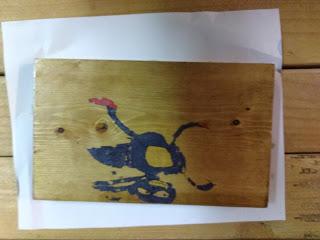
This unit in Woodshop, I got to learn how to use automatic saw machine and how to drill holes with a drill. It was an interesting class, I was a bit intimated at first with all the equipment, but after a few classes, I became comfortable with using these machines. The purpose of this class was to get comfortable using the machines and to create at least one design of our choice. The first classes were for us to get a hands-on experience with the drill, hammers, saw, and sander. The next few classes we started to create out image transfer. We chose images online for what we wanted to use for the image transfers.I decided to use a picture of sonic because it's funny and I like funny stuff.

To transfer the image onto the wood block, I first searched online for a picture. I chose Sonic because it was a funny meme. I think had to measure the size of the image so that it would fit on the block, this was pretty easy because it just took resizing the image. After that, I sent the picture to Aaron (our teacher) and he printed it out. Once it was printed we flipped the back of the image and put some sort of chemical that would make the image stick to the block. Once the image is on the block, we had to use a wet sponge to slowly remove the white paper from the block. Slowly but surely, the image was clear on the block. The only issue with this part was that I accidentally wiped too hard and some of the images disappeared. After that, we used some oil type chemical so that the picture would show up more clearly. Once we did that, we were done with the project!

LD, Image Transfer, 2018, Wood

Wednesday, December 13, 2017

Carve or DIE!

This unit in Rapid Prototyping, our class learned about 2.5D shapes, calculating the distance of a #D shape. The mass is how many atoms are an object. Density is how close the molecules are in an object and the volume of a rectangular prism is l*w*h. For the Field Experience, we went out to Harold Washington Library, to the program YOUMedia. We got a tour around the place and their Maker Lab. The purpose of this Action Project is to create 2 prototypes of a plaque regarding one of the school's core values, APGAA. This project made me think more about designing and how much technology has helped designers create their own ideas. I would like to use a program like Easel and hopefully will carve more in the future!


Thursday, November 30, 2017

Protoyping The Goals of the Nation

This unit in Rapid Prototyping, we learned about networks, traversable and shapes. Networks are a system of lines and vertices, if a shape is traversable, this means that it is traceable without lifting a writing device. To determine whether a shape is traversable they must either have 2 odd and the rest even or all vertices are even. The class visited Mhub, where they talked to the co-founder of Mhub and looked around the department, where they showed the CNC room and Workshop room. The purpose of this Action Project was to create a mini-poster of SDG goal by hand and by using a cameo-cutter. This AP was simple yet fun to complete, I liked using Silhouette STudio to cameo print my mini-poster. Below is my AP: Prototyping the Goals of the Nation

Tuesday, October 24, 2017

Walking the Streets of Underground rap

This unit in Journalism, the Senior class focused on the sound aspect of telling a story. We learned that sound is as important as the visuals of a story, for an FE a sound engineer named Luke came in to teach us what sound is and about the music theory. The purpose of this Action Project is to pick someone who has impacted people through their voice and develop a story from there in the form of a podcast. I chose to focus on Daniel Dumile(MF DOOM) an underground rap artist that started in the early 90's. I wanted to focus on MF DOOM while also exploring the idea of hip-hop and underground rap. I started my podcast with a story of how I began listening to MF DOOM, then I dive deeper into how hip hop has changed and with that change came (MF DOOM).The message I wanted the viewer to understand is that some artist will stay underground others will go on to become mainstream and just because an artist decides to make music for their specific audience that comes from the heart doesn't mean that they aren't as good as the next artist. This AP was a challenging one for me, I had never done a podcast and I don't consider myself to have a voice for the podcast. Despite these flaws, I created a story that I felt passionate about and wanted to give 110% to this AP.

Below is my podcast:


WHEN

WHO/HOW

WHAT
0:00


0: 10


0: 33


1:02


1:03


1: 42


2:03


2:18


2:25


2:26

2: 35

2:38

2:40

2:41

2:43

2:47

2:48


2:50

2:57


3:04


3:46

3:48

3:56


3:59


4:22


4:27


4:45


4:53


5:33

5:34

5:35


5:37

Laylah


cue Dooms Day


Fades out


Laylah


Laylah


Laylah


Laylah


Laylah


Alex

Laylah

Alex

Laylah

Alex

Laylah

Alex

Laylah


Alex

Laylah


Alex


Laylah

Manny

Laylah


Manny


Laylah


Manny


Laylah


Manny


Laylah

Manny

Laylah


Laylah
LWhen I was younger my dad drove my siblings and I to school every day. He would always go to Pandora and play a certain radio station, the usual would either be some 80’s funky music or some old school rap.

I remember one early morning, my dad turned on his phone, hooked it to the aux cord and began playing one of my favorite rappers today. I was captivated by the sample of Sade’s song, Kiss of Life and then even more intrigued by the beautiful flow of poetic words. Later that day,  I searched for the song, typing in every keyword I could remember, and finally, I found my hidden gem, MF DOOM.


Daniel Dumile aka Mf DOOM, Metal Face, Madvillain, Dangerdoom or Jj Doom is an England native that birthed his underground rap career in New York City during the 90’s. In 1988, he formed a group called KMD with his younger brother Subroc and was shortly then signed by Elektra Records. After their debut in 1993, Subroc was murdered and KMD was shortly dropped from Elektra Records.  Subsequently, after the death of Dumile’s brother, Dumile retreated from the rap scene, but in 1994 after 2 years of sleeping on the benches of Manhattan  Dumile re-emerged himself in the scene and started his lifelong passion for comic books and sci-fi through rap.


Dumile began freestyling at open-mic events in Manhattan anonymously while wearing a mask that was similar to Marvel Comics supervillain, Doctor Doom. This created his new identity alias: MF Doom, Ever since then, MF DOOM has never shown his face in interviews or shows without his mask. In 1999, MF DOOM released his first full and most famous album Operation: Doomsday.


I have been listening to MF DOOM Madvillain, Danger Doom and Viktor Vaughn for years after my discovery, but have never heard his music on mainstream radio.

Personally, I thought that Dumile was a great artist whose lyrics deserved to touch the hearts of many, but I guess others thought differently. I decided to go around my school and ask few of my classmates whether they listen to MF DOOM or not. Here's what they said.


Hi, can you state your name, age, and Occupation?


My name is Alexandria, I'm 17 and I'm a high school student.

Ok, and do you listen to MF DOOM?

No

Do you know who he is?

He’s a rapper..?

Yes, do you often listen to underground rap artist?

Yes, I guess you could say so.

If so, who?


Xxx Tentacion… I listen to Trippie Red, those people basically.

Do you prefer your underground rap artist to become more mainstream, if so why or why not?

I wouldn't just because I feel when you do become more mainstream your work as far as an artist becomes worse and you try to, I guess peer pressure yourself into doing what other artist are doing. Like talk about girls and crap and like big a****. Like basic stuff like you see all the rappers do. Like  DJ Khaled or whatever, he’s not even a rapper, roast…. ahahaha. He’s not a rapper but he has videos or whatever with like girls and stuff like that.

What’s your name, age, and occupation?

I’m Manny, I'm 17 and I'm a musician I guess you could say.

Do you listen to MF DOOM?


Uh, yeah,a lot actually. I mean, I used to listen to him a lot more, I listened to him a lot when I was a kid and I was really really studying rap, trying to figure it out, I guess… I don’t know. He’s always been one of the most influential people in my eyes and when it comes to the rap genre.

So, do you consider MF DOOM to be an underground rap artist?


Uh,  I feel like the term underground is kind of irrelevant now that the internet exists, because it’s kind of hard to be underground. I mean, compared to mainstream, like really mainstream artist, yeah he’s defiantly an underground guy because he doesn’t like the spotlight.

Mhm, do you prefer artist to be considered, “ underground”  or mainstream and why?


Uh, I honestly, when if I really like an artist, I prefer they don't get too big because you can’t get really big without changing your original sound. The mainstream has a certain pattern and mainstream artist fit into it, I guess,  and it’s hard to say that, but at the same time, it’s not because you can change the mainstream. But what you do has been something that completely appeals to everybody to be able to change the mainstream. MF DOOM doesn’t have something that will appeal to everybody. He has something that appeals to people that really like lyrics and really like the essence of what hip-hop is.


Thank you!

You’re welcome.

Bye!


I can’t help but wonder if MF Doom were to be signed to a or become more famous if his music sound would change and become mainstream. As much as I”d like for my favorite artist to become more famous, staying an underground artist is what keeps them unique.